

Sizing and structure
Choosing the Right Outdoor Sign Thickness
Thickness affects rigidity, weight, carving depth, edge appearance, hardware and price. The right choice starts with the finished size and how the sign will be supported.
Expert guidance
What you should know
Thickness affects rigidity, weight, carving depth, edge appearance, hardware and price. The right choice starts with the finished size and how the sign will be supported.
Why thickness matters
A thin sign may flex across a wide span, while an unnecessarily thick sign adds weight and shipping cost. Deep carved designs also require enough remaining material beneath the toolpath.
MDO thickness
For many residential routed signs, three-quarter-inch MDO provides a strong, substantial panel and enough depth for crisp carving. Smaller protected signs may use thinner stock, while broad signs may require thicker material or a supporting frame.
PVC thickness
PVC thickness should be selected with span and heat exposure in mind. Because it is less rigid than plywood, a large PVC sign may need additional thickness, backers or more mounting points.
Maker’s advice: Send us a photo of the installation area, finished dimensions and exposure details. Material and design recommendations are much more accurate when we can see the actual space.
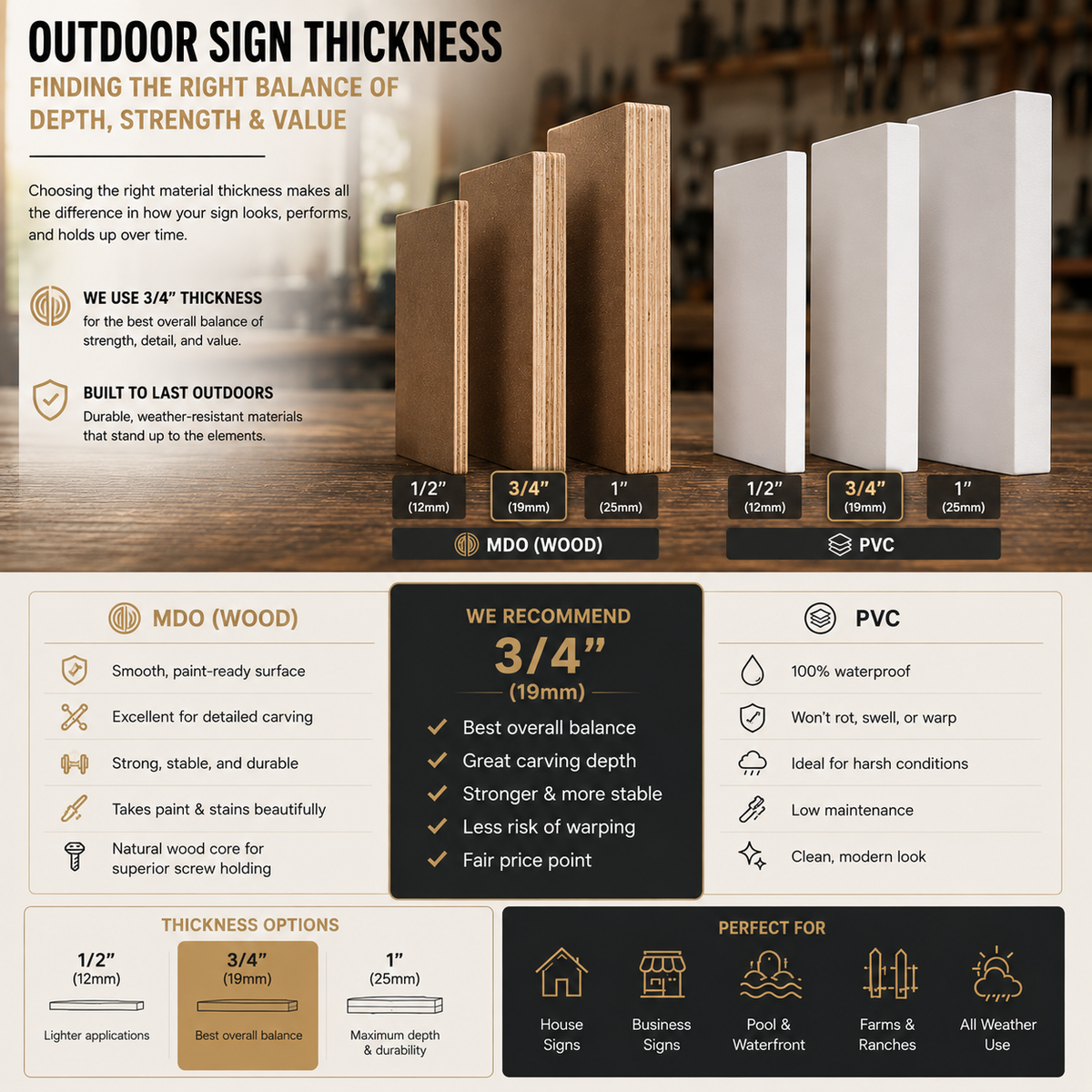
we find 3/4 inch is a great balance
Mounting changes the calculation
A sign supported continuously against a wall behaves differently from one hanging between posts. Wind load, fastener spacing and the distance between supports should guide the final choice. Sometimes your intended use may change and 3/4 inch material is usually up to any task.
Quick comparison
At-a-glance comparison
Use this table as a starting point. Your finished size, exposure and installation can change the recommendation.
| Application | Common starting point | Important note |
|---|---|---|
| Small door or porch sign | 1/2 to 3/4 inch | Balance weight with edge presence |
| Typical backyard wall sign | 3/4 inch | Strong all-around choice for routed MDO |
| Large fence or garage sign | 3/4 inch or engineered support | Span and mounting matter more than width alone |
| Freestanding or post-mounted | Project-specific | Wind load and structure require planning |
Planning details
Put the advice into practice
Strong outdoor signs come from combining the right material, readable design, compatible finish and secure installation.
Carving depth and small details
Deep relief and narrow letter strokes can conflict. Designs should preserve enough material around fragile areas and avoid cutting so deeply that the remaining panel becomes weak.
Common questions
Frequently asked questions
Is thicker always better?
No. Extra thickness adds weight and cost and may not solve a poor mounting design.
Can a large sign be made from half-inch PVC?
Possibly with proper backing and support, but unsupported spans require careful engineering.
How deep should lettering be carved?
Depth depends on material, letter size, tool diameter and the remaining strength around details.
Can you recommend thickness before I order?
Yes. Send the finished dimensions, material preference, placement and mounting plan.
Ready to plan your custom sign?
Tell us where the sign will be installed, how large it needs to be and what style you have in mind. We will help match the material and design to the project.